
 044 209 20 90

Emergency abdominal surgery
Visceral surgery treats diseases of the abdominal organs and abdominal wall. In addition to planned operations, abdominal surgery also includes emergency treatments. While many patients assume that surgeons always operate immediately, the reality is often different. Before an operation, numerous clarifications are required and conservative, i.e., non-surgical therapy is often necessary.
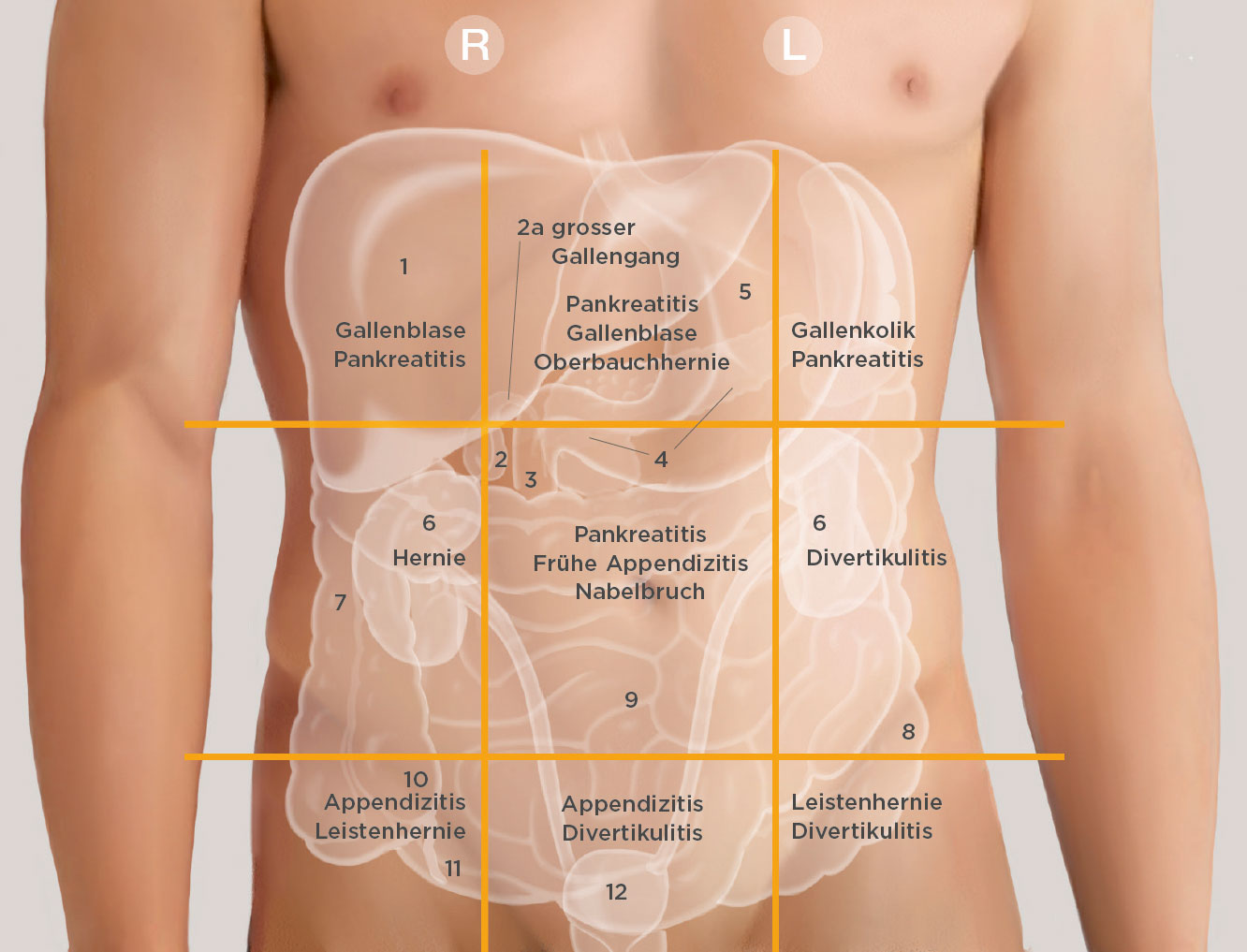
The location of abdominal pain provides an initial indication of its possible cause. However, the location of the pain does not always correspond to the location where it originates.
Abdominal organs
1 Liver
2 Gallbladder
2a Common bile duct
3 Duodenum
4 Pancreas
5 Stomach
6 Kidneys
7 Ascending colon
8 Sigmoid colon
9 Small intestine
10 Cecum
11 Appendix
12 Bladder
Emergency departments such as that of Klinik Im Park are open around the clock for people with an acute medical problem. These frequently include patients with abdominal pain. In such cases, the emergency team first evaluates the pain: Where is it located? Is it dull, rhythmic and recurrent like colic, or sharp (see Fig. 1)? This is followed by a medical history focusing on the duration and onset of symptoms, any previous operations, and current medications. At the same time, the pain must be treated appropriately and an initial suspected diagnosis established. During the careful manual examination, attention is paid to guarding, masses (resistance or hardening), and localized points of tenderness. This is followed by blood tests (inflammatory markers, elevated or reduced values of individual organ systems such as the liver or kidneys) and imaging (ultrasound, X-ray and/or CT).
At a certain point, the on-call surgeon is consulted to discuss the findings and the suspected diagnosis. Common diagnoses in the emergency department include inflammation of the appendix (appendicitis), the gallbladder (cholecystitis), and the intestine (diverticulitis). Painful hernias of the abdominal wall, groin, umbilicus, or in the area of surgical scars are also not uncommon.
In some cases, an emergency operation can be avoided in favor of a later, planned procedure. If surgery is required, it is performed minimally invasively in most cases. Thanks to modern anesthesia, this elegant surgical technique is often possible even in elderly or frail patients.
Diverticula
Diverticular disease, known as diverticulosis, consists of outpouchings of the intestinal wall, typically in the left, descending portion of the colon, which extends in an S-shape toward the rectum. Diverticula form at weak points in the intestinal wall, often where blood vessels penetrate it. If stool becomes trapped in these areas, severe inflammation can occur—this is then referred to as diverticulitis—which may lead to perforation of the diverticula. In the worst case, stool can leak into the abdominal cavity. The penetrating blood vessels can also be damaged by the inflammation and cause sometimes severe bleeding. The incidence increases after the age of 50, although younger people may also be affected. Patients may experience very severe pain in the lower left abdomen and feel generally unwell with fever.
In many cases, initial conservative treatment with pain medication and antibiotics is possible. In the event of an intestinal perforation with gas and stool in the abdominal cavity, emergency surgery is required. This procedure can usually be performed minimally invasively. Sometimes, however, a larger abdominal incision cannot be avoided, for example if there have been previous abdominal surgeries or if the inflammation is very advanced. The aim of the operation is to remove the diseased segment of the intestine and then reconnect the remaining ends.
Patients recover to varying degrees after such procedures, depending on whether surgery was performed in an emergency setting or after conservative treatment that allowed the inflammation to subside. Recovery and complication rates also naturally depend on the patient’s age and comorbidities. On average, patients remain in hospital for one week.
Hernias
Hernias are defects of the abdominal wall that typically occur at weak points. The most well-known is the inguinal hernia. In men, the inguinal canal contains the testicular vessels and the spermatic cord. A hernia can develop at the point where these structures pass from the abdominal cavity into the inguinal canal. If the musculature is weak, the hernia may also protrude directly through a gap in the muscle into the inguinal canal. A similar situation exists with umbilical hernias, where a small gap often remains as a remnant of the umbilical cord passage. Hernias can also occur at other sites of the abdominal wall, depending on connective tissue quality and factors such as heavy physical exertion. Because of discomfort or cosmetic appearance alone, affected individuals rarely present to the emergency department. They usually seek care when fatty tissue or even parts of the intestine become trapped in these gaps. This leads to severe pain and a pronounced feeling of illness, particularly if the trapped intestinal wall ruptures.
Here too, a minimally invasive procedure is usually chosen. In modern hernia surgery, synthetic meshes are placed to reinforce the defect. This can reduce recurrence rates to 1–2 percent. Depending on how the patient feels, full physical activity can often be resumed immediately after surgery. Patients usually go home after 1 to 3 days.
Gallbladder
The gallbladder is attached to the liver. It can contract and release the bile stored within it into the duodenum to aid digestion. The gallbladder is supplied via the common bile duct. Through this duct, bile produced in the liver flows partly directly into the duodenum and partly through the cystic duct into the gallbladder for storage.
The gallbladder can become inflamed if bile outflow is impaired due to stone formation. Of particular concern is when a stone migrates from the gallbladder into the common bile duct, where it can become lodged just before its entry into the duodenum and may also block the pancreatic duct. This results in additional inflammation of the pancreas, which at best is extremely unpleasant and at worst can cause serious complications. All age groups and genders can be affected, but there is an increased incidence among overweight women of childbearing age with fair skin and hair and a positive family history.
Signs of disease may include a feeling of pressure or nausea, especially after eating. An emergency arises when colicky pain develops due to passing stones or severe inflammation, which may cause pain, general malaise, and fever. Patients are further evaluated using blood tests, ultrasound, and/or computed tomography. If congestion of the common bile duct and the intrahepatic bile ducts is detected (based on elevated liver enzymes), gastroenterologists are usually consulted to perform an endoscopy to relieve the blockage and allow digestive juices to drain into the duodenum. Often, the pancreas is also inflamed, making it necessary to delay surgery until blood values improve. Otherwise, surgery can be performed promptly and is minimally invasive in most cases. During the procedure, the gallbladder—which is not essential for life—is completely removed. After surgery, patients can eat normally, and full physical activity is possible depending on symptoms. Most patients go home after 1 to 3 days.
Appendix
Inflammation of the appendix, appendicitis, is a very common condition affecting all genders and age groups. The appendix is located at the junction of the small and large intestine in the right lower abdomen. Typical symptoms include right lower abdominal pain and, in more severe cases, a pronounced feeling of illness with fever. The appendix becomes inflamed when stool becomes trapped within it. Conservative treatment with pain medication and antibiotics is only considered in exceptional cases. Normally, minimally invasive surgery is performed promptly. The appendix is divided at its base in an area free of inflammation. If the inflammation has spread to other sections of the intestine, the entire transitional area may need to be removed. In that case, the small intestine must be connected to the large intestine with a suture, which requires a larger abdominal incision. Removal of the appendix, known as an appendectomy, is now a routine procedure, but depending on the extent of inflammation it can be very demanding. Patients can leave the hospital shortly after the procedure and move freely depending on symptoms. A particularly restrictive diet is not necessary.
Dr. med. Christian Gingert
Specialist in Surgery
Focus on Visceral Surgery